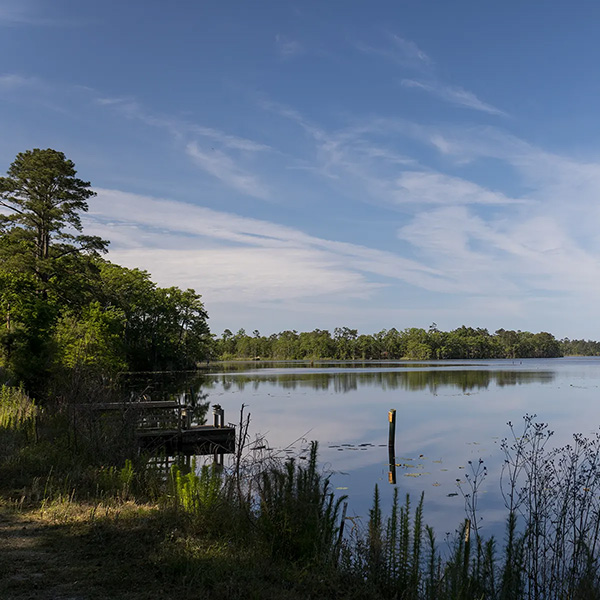
I was down along the Cape Fear River in Cumberland County recently, doing what I usually do—wandering around with no particular destination—when I spotted a tangle of bright red flowers climbing up the bank along the water’s edge.
Trumpet creeper.
Now, I realize that doesn’t sound like the kind of thing that ought to get somebody excited, but it made me grin.
I don’t think I’ve ever lived anywhere in North Carolina where I didn’t see trumpet creeper growing somewhere nearby. It doesn’t matter if you’re in the mountains, the Piedmont, or the Coastal Plain. This vine has already beaten you there. It’ll be climbing an old fence post, wrapping itself around a pine tree, or swallowing half an abandoned tobacco barn like it signed the deed years ago.
There’s a good reason for that: it belongs here. Trumpet creeper (Campsis radicans) is native across the entire state, and once you learn to recognize it, you’ll start seeing it everywhere.
It’s collected a handful of names over the years, too. Trumpet vine. Hummingbird vine. Cow-itch vine.
That last one is less of a nickname and more of a warning label.
The flowers are what stop you in your tracks. They bloom in clusters of brilliant orange-red trumpets with sunny yellow throats, each one looking like nature decided hummingbirds deserved their own drive-thru window.
Here in North Carolina, they usually start blooming in June and keep going through September, with the real fireworks arriving in July and August. Along the coast they’ll sometimes hang around into October if summer decides not to leave on time.
And that’s when the hummingbirds show up in force.
If you’ve ever watched a ruby-throated hummingbird zigzag from flower to flower on a sticky Carolina afternoon, you know exactly what I mean. They treat trumpet creeper like it’s an all-you-can-eat buffet. Bees and butterflies usually aren’t far behind.
Now let’s talk about the vine itself.
This plant has never met a boundary it respected.
Given half a chance, it’ll climb 30 or 40 feet up a tree, a fence, a telephone pole, your pergola, or probably your neighbor if they stand still long enough. It clings with tiny aerial rootlets that practically say, “I’m living here now.”
It’s beautiful.
It’s native.
It’s also just a little bit feral.
And honestly, that’s part of its charm.
It spreads by underground suckers, drops seeds wherever the wind feels like carrying them, and generally approaches gardening with the confidence of a toddler who’s had too much birthday cake. That’s not necessarily a bad thing. It just means you don’t plant trumpet creeper unless you’re prepared for trumpet creeper.
If you’ve got an ugly chain-link fence, a sturdy arbor, or a big trellis that could use some life, this vine can absolutely transform it. The dark green, fern-like leaves stay handsome all summer before fading to soft yellow in the fall. Just make sure whatever it’s climbing is built like it means it. Mature vines get surprisingly heavy.
And remember that “cow-itch vine” nickname?
Turns out folks weren’t being dramatic.
The sap can irritate your skin, so wear gloves unless you enjoy finding out whether your forearms are allergic to poor decisions.
If you’d rather have the flowers without quite so much enthusiasm, there are a couple of cultivated varieties worth looking for. ‘Flava’ produces gorgeous golden-yellow blooms, while ‘Madame Galen’ offers oversized orange-red flowers with a slightly better sense of boundaries than the straight native species.
Plant it in spring or fall, keep it watered during its first season, and after that it’ll mostly take care of itself. Sandy soil? Fine. Clay? Fine. Dry spell? It’ll complain less than I do. It’ll grow in partial shade, but if you really want a show, give it plenty of sunshine.
I think that’s why I’ve always loved trumpet creeper.
It’s not rare or delicate. Nobody’s putting it in a crystal vase or fussing over it in a greenhouse.
It’s just a hardworking North Carolina native that’s been climbing our trees, brightening our roadsides, and feeding hummingbirds long before any of us got here.
It doesn’t ask permission.
It doesn’t apologize for taking up space.
It simply blooms where it finds itself.
And maybe that’s why it feels so right here.
North Carolina is changing. Old farms become subdivisions. Back roads become four lanes. Empty fields become shopping centers. Every year, the landscape looks a little different than it did before.
But every summer, trumpet creeper still finds a fence row, a riverbank, or the edge of an old woodline and reminds me that some things refuse to disappear.
Maybe that’s what I love most about it.
Not that it’s flashy.
Not that it’s everywhere.
But that it keeps showing up, year after year, stubbornly wild, completely at home, and entirely itself.
I hope North Carolina never loses that.