While Belle and I wandered around Wilkesboro a couple of weeks ago, I spotted a log cabin tucked behind the old jail on East Main Street and headed straight for it.
Belle followed without complaining. That young’un has learned.
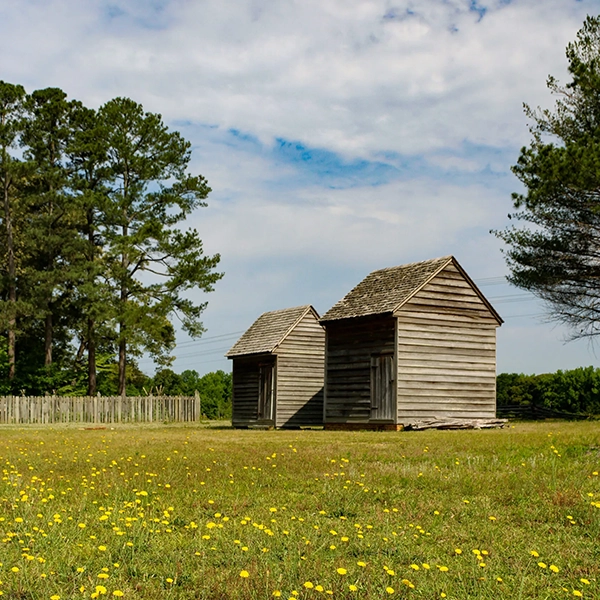
The Robert Cleveland Log House sits quietly on the grounds of the Wilkes Heritage Museum. It doesn’t have the grandeur of Biltmore or the dramatic setting of some of North Carolina’s better-known historic sites. It’s just a simple log house, weathered by time.
And yet, the moment I stepped up close and really looked at those hand-hewn logs, I felt it.
I’ve been having that reaction a lot lately. With America approaching its 250th birthday, I find myself standing in old places and doing the math — realizing my ancestors would have recognized this world. Maybe not this exact spot, but something very much like it.
That realization never gets old.
Robert Cleveland was born in Virginia in 1744 and made his way into the Carolina backcountry as a young man, settling in what is now Wilkes County. Like so many families who pushed south and west through the mountains, he came looking for opportunity and land.
He married Alice “Aley” Mathis, raised a large family, farmed the rich Yadkin Valley, and served as a captain in the North Carolina militia during the Revolutionary War. In 1780, he fought at Kings Mountain alongside his brother, Colonel Benjamin Cleveland, whose name would become much better known in North Carolina history.

After the war, Robert returned home, built a life, raised his family, and remained active in his community until his death in 1812.
But what caught my attention wasn’t the military service or the family connections.
It was the house.
Built in 1779–1780 — while the Revolutionary War was still raging — along the North Fork of Lewis Fork Creek, the cabin was substantial by backcountry standards. Two stories tall with stone chimneys at each end, it was constructed using distinctive diamond-notch joinery, a technique that required real skill and wasn’t common in this part of North Carolina.

Standing in front of it, I couldn’t stop studying the craftsmanship. Every log had to be cut, shaped, lifted, and fitted by hand. No power tools. No shortcuts. Just hard work and determination. And more than two centuries later, it’s still here.
The house remained on its original site for over 200 years before being carefully dismantled and relocated to Wilkesboro in 1986. Piece by piece, it was restored and reconstructed, preserving one of the finest surviving examples of Revolutionary-era architecture in the region.
As I walked around it, I found myself thinking less about Robert Cleveland and more about the countless families who lived lives much like his.
Some of my own ancestors were settling western North Carolina during that same period. They weren’t famous. Most left behind little more than a name in a census record, a deed book, or a weathered headstone.
But they were here.
They built homes. Raised children. Worked the land. Endured hard winters and uncertain times. They made decisions that shaped generations they would never live to meet.
That’s what I think about when I visit places like this.
History isn’t just the story of generals, politicians, and famous names. It’s also the story of ordinary people who built lives in the Carolina backcountry and stayed long enough for their descendants to still be here 250 years later.
Maybe that’s why old houses affect me the way they do. They remind us that history isn’t nearly as far away as it sometimes feels.
If you find yourself in Wilkesboro, take the time to visit the Robert Cleveland Log House behind the Wilkes Heritage Museum. Walk around it. Look closely at the logs. If your roots run deep in North Carolina — especially in the foothills and mountains — I suspect you’ll feel it too.
Two hundred and fifty years sounds like a long time.
Standing in front of that house, it felt more like yesterday.