

Back in March, the NC Libertarian Party invited me to cover their state convention as a content creator — and I turned it into a mother-daughter adventure.
That part was non-negotiable. My girls needed to experience Lake Lure.
I spent most of the weekend working, filming and interviewing attendees and covering the events of the convention. If you’re interested in that side of the trip, you can find all of those videos over on YouTube and Rumble.

But whenever my schedule allowed, I slipped away with Bug and Belle to explore a little, enjoy a good meal, and soak up the beauty of Hickory Nut Gorge.
The convention may have brought me there, but Lake Lure is what stayed with me.
We spent the weekend at the Lake Lure Inn, and by the time we headed home, I found myself thinking as much about the history of the place as I did the event I had come to cover.
The Lake That Didn’t Exist
One of my favorite things about North Carolina is discovering the stories hiding beneath the surface of places I’ve visited my entire life.
And Lake Lure has a fascinating one.
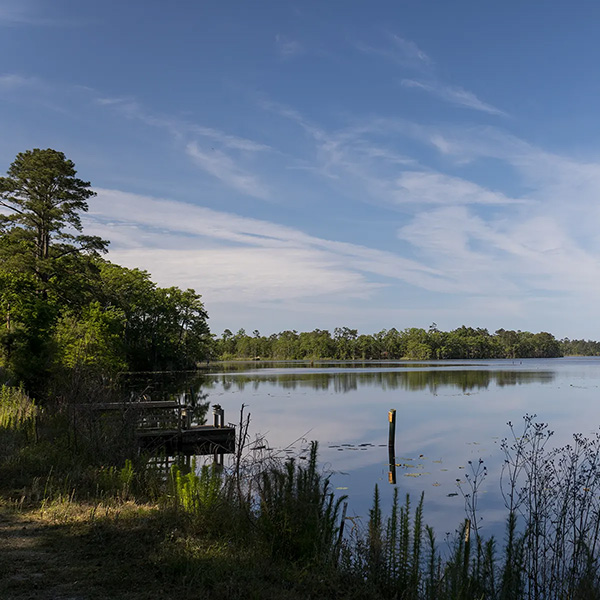
Most people assume it’s a natural mountain lake. It certainly looks the part, nestled among the Blue Ridge foothills with ridgelines reflected in water so still it sometimes looks painted.
But the truth is that Lake Lure didn’t exist until the 1920s.

The man responsible was Dr. Lucius Morse, a physician from Missouri who came to Western North Carolina after being diagnosed with tuberculosis. Like many people during that era, he was advised to seek a milder climate, and the thermal belt of these mountains offered exactly that.
At some point during his recovery, he climbed to the top of Chimney Rock and looked out across Hickory Nut Gorge.
Most people would have admired the view and gone home.

Dr. Morse decided to buy it.
Along with his twin brothers, Hiram and Asahel, he began acquiring land around Chimney Rock. What started as a modest purchase eventually grew into roughly 8,000 acres. He envisioned an entire resort community — a destination unlike anything else in the South, complete with an inn, a yacht club, a zoo, and a lake that didn’t yet exist.
There was only one obstacle.
The Rocky Broad River flowed through the gorge, but there was no lake.
So they built one.
Construction began on a dam at Tumbling Shoals in 1925. When the dam was completed, the waters of the Rocky Broad backed up into the valley, creating the 720-acre lake we know today.
In the process, a small farming community called Buffalo disappeared beneath the rising water. Somewhere beneath those peaceful, painted-looking waters are the remains of roads, fields, and homesteads where families once lived their everyday lives.
By 1927, Lake Lure was complete, with nearly 27 miles of shoreline winding through the mountains. The town incorporated that same year, and Dr. Morse’s wife, Elizabeth, gave the lake its name.
Nobody seems entirely certain why she chose it. Maybe it referred to the fishing. Maybe it referred to the scenery. Standing on the shoreline myself, I suspect she simply understood the power this place has over people.
The stock market crash of 1929 ended many of the larger plans. The yacht club was never built. Neither was the zoo. But the lake remained.
And nearly a century later, it still draws people in.
The Lake Lure Inn

If Lake Lure is the heart of the community, the Lake Lure Inn is its memory.
The Inn opened in 1927 alongside the new lake and quickly became the centerpiece of Dr. Morse’s vision for the area. Built in the Mediterranean Revival style, it was designed to evoke the lake districts of northern Italy, with stucco walls, graceful arches, and red-tiled roofs.
Much of the larger architectural vision never materialized after the Depression. Thankfully, the Inn did.
Walking through its doors feels less like checking into a hotel and more like stepping into another era. The original hardwood floors still creak beneath your feet. Antique artwork hangs on the walls. Historic photographs and newspaper clippings tell the story of the generations who have passed through.
And what a list that is.
President Calvin Coolidge visited. Franklin Roosevelt stopped by. F. Scott Fitzgerald signed the guest register. Emily Post did too. During World War II, thousands of combat airmen found rest there before returning overseas. And decades later, Patrick Swayze and Jennifer Grey called it home while filming Dirty Dancing nearby.
You can feel all of that history around you.
The Inn has been called “the little Waldorf of the South,” and after staying there, I understand why.
The Shadow of Helene

It’s impossible to talk about Lake Lure today without talking about Hurricane Helene.
When the storm tore through Western North Carolina in September 2024, Lake Lure and Chimney Rock found themselves directly in its path. The historic bridge leading into Chimney Rock was swept away. Businesses suffered extensive damage. The lake itself had to be drained so crews could begin the enormous task of cleanup and recovery. Revenue for the area dropped by 50%.
For a community built around tourism, the impact was devastating.
When my daughters and I visited in March, recovery efforts were still visible everywhere we looked. There was a sense of determination in the air, but there was also grief. You could see both at the same time.
The mountains were still beautiful. The people were still welcoming. Yet there was no hiding the scars.
What struck me most was the resilience. People weren’t sitting around waiting for someone else to save them. They were rebuilding. Business owners were reopening. Workers were repairing. Neighbors were helping neighbors.
Since then, the progress has been remarkable. Chimney Rock State Park reopened nine months after the storm. The lake itself welcomed visitors back in May 2026, after more than a year and a half of closure — the mayor said she wasn’t sure the businesses could have survived another season without tourists coming back.
That recovery didn’t happen by accident. It happened because people refused to give up on WNC.
And that’s exactly why I want to encourage folks to visit. Not out of pity. Not as charity. But because these mountain communities are open, they’re working hard, and they deserve to be supported. Every hotel booking, every restaurant tab, every souvenir purchased helps local families continue rebuilding after one of the hardest chapters in recent memory.
Where We Ate
One of the best ways to support a community is to enjoy what makes it special, and in our case that meant eating our way through every free hour we could find.
Lured

Every single one of us loved Lured. The standout was the fried pickled okra — crispy, tangy, perfectly seasoned, and somehow impossible to stop eating. I’ve eaten okra every way imaginable, but theirs deserves special recognition. If you order one thing there, make it that.
La Strada

For Italian, we ended up at La Strada. The pasta was exactly what you want after a long day in the mountains — the kind of meal where you clean the plate without quite meaning to and then sit there a little longer than you planned because nobody wants to leave. Good food. Good atmosphere.
River Watch

We also spent some time over in Chimney Rock Village and stopped at River Watch. Their baked potato salad may have permanently ruined all other potato salad for me. I’m not sure exactly what’s in it. I don’t need to know. I just know I’d gladly drive back for another serving.
I’ve visited a lot of places across North Carolina. Lake Lure is one of my favorites.
It’s the mountains reflected in still water. It’s century-old stories hiding around every corner. It’s a community that has endured one of the worst storms in American history and is still standing.
If you’ve been considering a mountain getaway, put Lake Lure and Chimney Rock on your list. Stay at the Inn, eat at the local restaurants, walk the shoreline, and spend your money there with joy in your heart. Behind every storefront and restaurant table is a local family that has fought hard to keep this place going.
Lake Lure is one of those rare North Carolina places that gets into your blood.
Some places are beautiful. Others feel like they have a soul. Lake Lure somehow manages to be both — and once it gets its hooks in you, you’ll understand exactly why people keep coming back.


I didn’t know about the history of Lake Lure, but it is a beautiful place. In 1984, I was directing a BSA camp not far from there and dating an absolutely stunning woman (who should have been a model). We went to a play at Carl Sandburg’s home on a Saturday night and stopped by Lake Lure and talked on a bench until about 1 AM. It was the first time we discussed marriage (we didn’t marry, thankfully). But also in that night, she used the N-word (not nuptials) which showed a side of her than eventually brought the relationship to an end. Interesting memories of that place and funny how things work out. But it was a romantic setting.
At least you figured it out before it was too late – and you figured it out in one of the most beautiful spots in the whole state. lol